Blog
Stop Bookmarking AI Tutorials. Do This Instead.
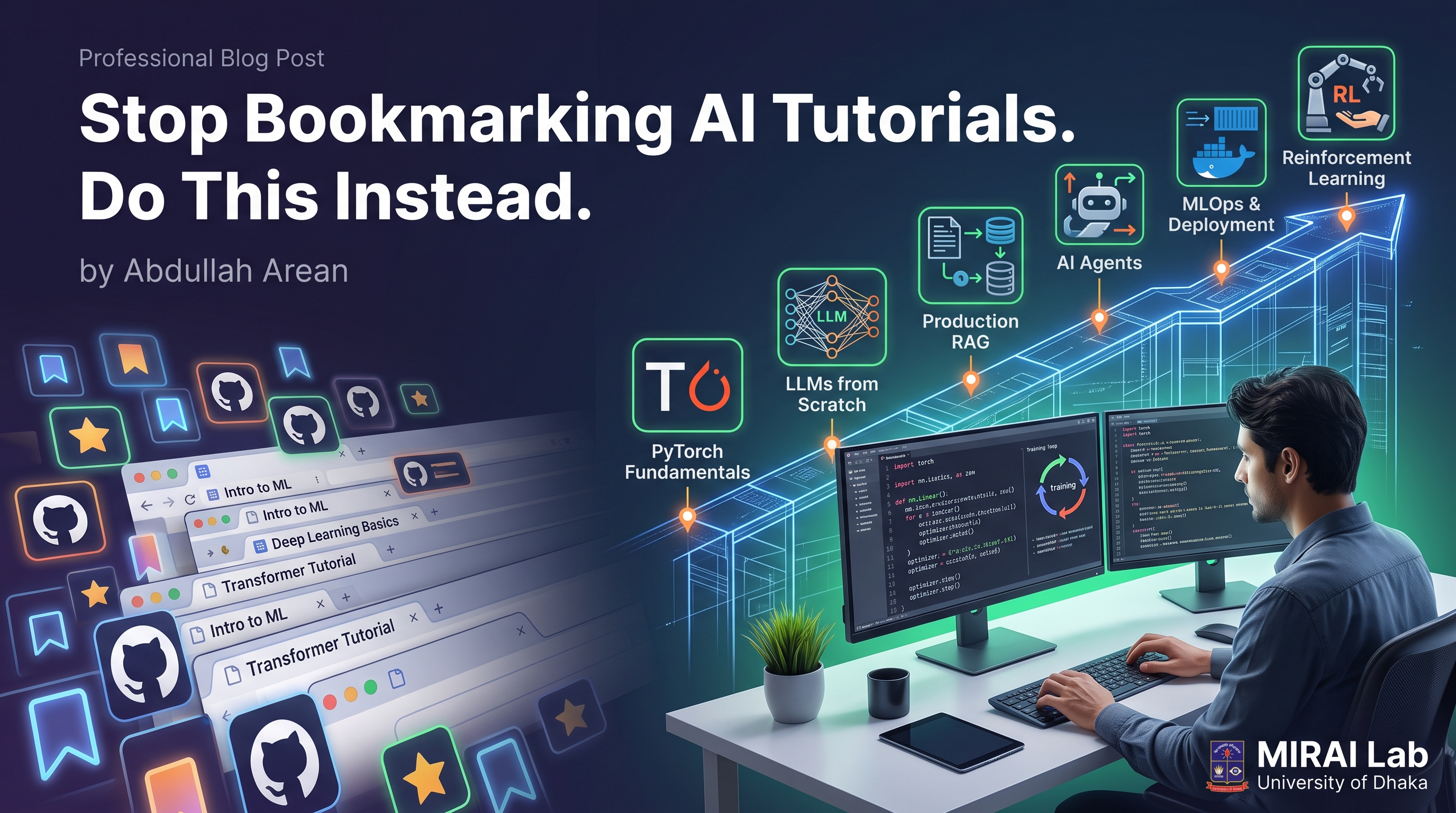
You know the drill. You find a massive list of machine learning resources, star the repository, bookmark the page, and never look at it again.
It happens because a giant list is not an execution plan. The trick to actually learning this stuff is not finding the perfect collection of links. It is picking a single starting line and putting in the reps.
Here is a practical roadmap that takes you from PyTorch fundamentals all the way to production systems, agents, and reinforcement learning. I dug up the missing URLs from the original list so you do not have to search for them. Every step builds the foundation for the next.
Step 1: Fluency First (Start With PyTorch)
Before you touch transformers or agents, you need to get fluent in the framework you will use for almost every project.
- Watch: Learn PyTorch. This is a hands on introduction that gets you writing real code quickly instead of putting you to sleep with theory.
- Work through: The Official PyTorch Tutorials. Use these right alongside the video to fill in the gaps. You need to get comfortable with their documentation style because you will be living in these docs later.
- Read: Deep Learning with PyTorch. Do not read this cold. Use it after you have the basics down to solidify what you have already practiced.
Your goal: You should be able to write a training loop, define a model, and understand tensors and data loading without Googling basic syntax.
Step 2: Under the Hood (Deep Learning From Scratch)
Once PyTorch feels natural, you need to go one level deeper. You need to understand what is actually happening mathematically.
- Watch the full series: Neural Networks: Zero to Hero by Andrej Karpathy. This playlist walks you from backpropagation built by hand all the way up to a GPT built from raw operations.
Your goal: You understand backpropagation and gradient descent well enough to reimplement a tiny neural network without relying on a framework.
Step 3: The Heavy Lifting (Build an LLM From Scratch)
This is where things get serious. You are going to build a GPT style model yourself instead of just fine tuning an existing one.
- The Primary Course: Build LLMs From Scratch by Vizuara. You will learn how GPT-3 actually works, the BPE tokenizer, multi head attention, and how to code a 124M parameter model.
- The Follow Up: Let's Reproduce GPT-2 (124M). This is Andrej Karpathy's famous deep dive that rebuilds GPT-2 from first principles.
- Scale Your Understanding: Distributed Training with PyTorch by Umar Jamil. This covers Distributed Data Parallel, collective communication, and gradient accumulation.
- Modern Architecture: Build DeepSeek from Scratch by Vizuara. This gets you up to speed on the KV cache, mixture of experts, multi token prediction, and quantization.
- Academic Grounding: Stanford CS336: Language Modeling From Scratch.
Your goal: You can explain and reimplement tokenization, attention, and the training loop of a small GPT.
Step 4: The Reality Check (Production RAG)
Retrieval Augmented Generation is where toy projects fall apart. A quickstart script will not survive contact with messy corporate data. This step bridges the gap between demo and production.
- The Workshop: Production Level RAG Workshop by Vizuara. You will learn PDF parsing strategies, chunking trade offs, and reranking.
- The Roadmap: The Mother of AI Project. This is a multi week GitHub roadmap covering RAG from zero to hero, hybrid search using OpenSearch, and MLOps monitoring.
Your goal: You can build a pipeline that handles real documents, make intelligent chunking decisions, and set up basic system monitoring.
Step 5: Autonomy (AI Agents)
With retrieval and generation covered, it is time to move into systems that can plan and act autonomously.
- Core Patterns: Building AI Agents From Scratch by The Neural Maze. Covers reflection, tool use, and multi agent patterns.
- Graph Orchestration: LangGraph Workshop by The Neural Maze. Covers LLM nodes, chains, routers, and cycles.
- Protocol Integration: The Neural Maze Channel. Check their recent uploads for their full course on building an MCP Video Agent using the Model Context Protocol, Docker, and React.
Your goal: You understand reflection and planning, you can build a graph based workflow, and you have built at least one MCP integration.
Step 6: The Bottleneck (Inference at Scale)
Once you can build agents and RAG pipelines, your next wall is serving models efficiently.
- Read: A Practical Guide to LLM Inference at Scale by Miguel Otero Pedrido and Antonio Zarauz Moreno.
Your goal: You understand the practicalities of serving models using tools like vLLM, mastering batching, and handling throughput versus latency trade offs.
Step 7: Ship It (Docker)
Everything you have built is useless if it only runs on your laptop. You need to package and ship it reliably.
- Watch: Docker Tutorial for Beginners.
Your goal: You can containerize a Python service, write a clean Dockerfile, and run it reproducibly anywhere.
Step 8: Keep the Engine Running (MLOps)
MLOps is a moving target. You need a steady stream of operational knowledge to stay relevant.
- Subscribe to: Rajinikanth Vadla on YouTube for hands on tutorials on MLOps, AIOps, and Agentic AI.
- Subscribe to: DSwithBappy for ongoing content covering Data Science, Computer Vision, and CI/CD pipelines.
Your goal: You build a habit of following operational best practices as they evolve.
Step 9: The Next Frontier (Reinforcement Learning)
This is the final stop on our roadmap. It is the foundation for how modern LLMs are post trained.
- Watch the full series: DeepMind x UCL Introduction to Reinforcement Learning.
- Work through: The Deep Reinforcement Learning Course by Hugging Face.
Your goal: You understand value functions, policy gradients, and the exploration versus exploitation trade off well enough to grasp how RL actually shapes the behavior of today's top models.
The Point of All This
Sharing a bare list of links was never the goal. What matters is the progression.
Fundamentals lead to building from scratch. Building from scratch leads to production systems. Production systems lead to deployment.
Do not jump straight to whatever topic is trending on Twitter this week. Scroll back up to Step 1. Click that first video and start right now.